
New Insight Into EXPLORATIONS (Bill Evans Trio)
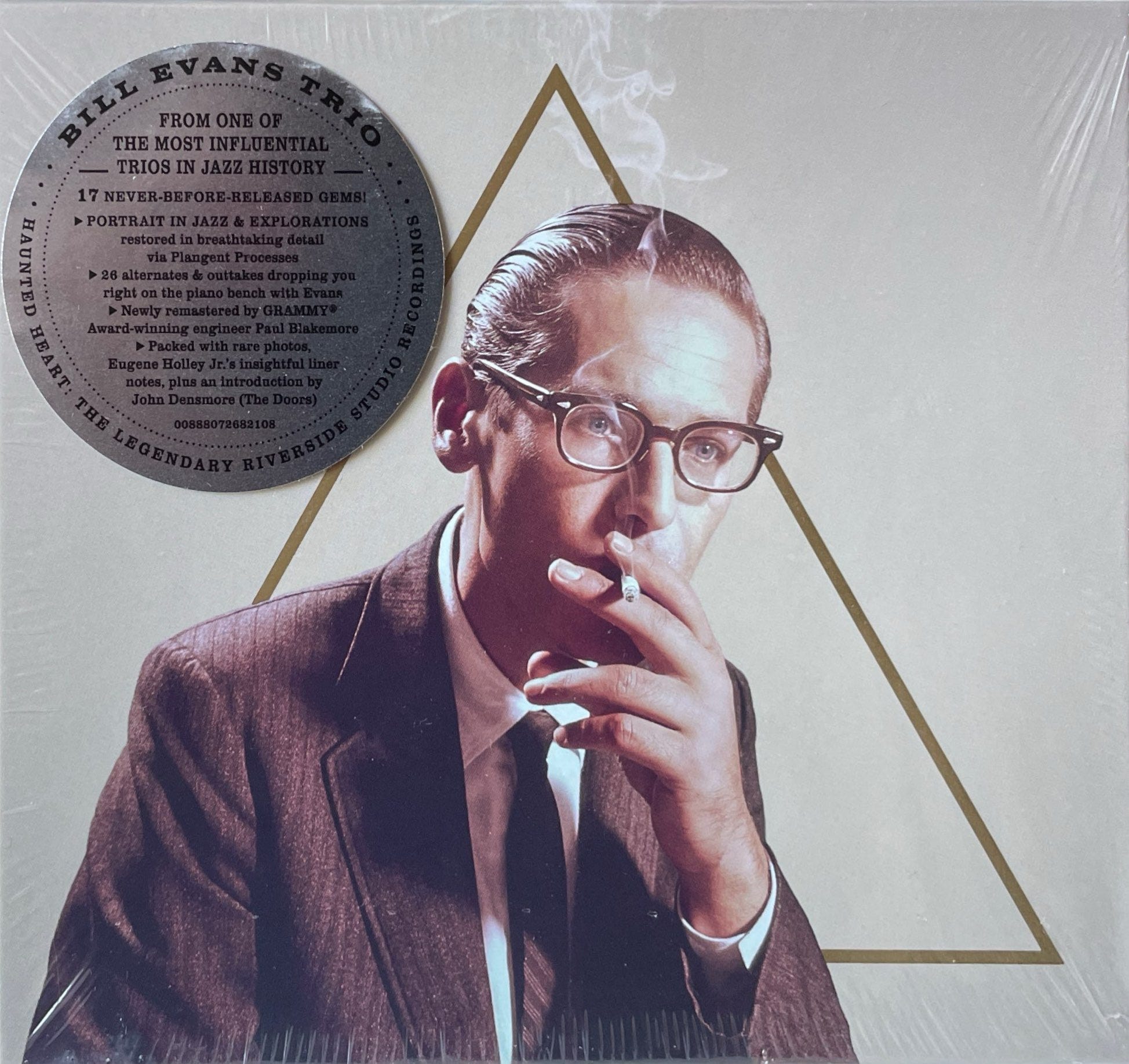
HAUNTED HEART: The Legendary Riverside Studio Recordings (Craft) raises many questions and answers some of them.

November 28: In reviewing my data I caught a bone-headed error; correcting it results in a more grounded analysis. The sortable table has been amended, and my essay has been adjusted in response.
Craft has just issued the most complete edition of the Bill Evans Trio’s studio sessions that we’re every likely to get. They’ve smartly refrained from calling it “Complete,” because it ain’t! It may be the complete surviving tapes, or the realized takes, or the estate-approved tracks, but it is not the complete session, which is to say it hasn’t gotten the obsessive treatment merited by Charlie Parker’s Savoy sessions or Glenn Gould’s 1955 Goldberg Variations (with every false start, breakdown, and overheard speech). Just as well: every master and alternate take drawn from the Portrait In Jazz and Explorations sessions is a fully realized performance (even if the self-critical Evans didn’t think so at the time).
Explorations has always been a confounding masterpiece. We’re told of bad blood between Evans and LaFaro, for example, and that LaFaro kept to the lower register as he was playing a borrowed instrument. Compared to Portrait in Jazz and the Village Vanguard albums, LaFaro’s lines are muddy and foreboding. But if LaFaro doesn’t soar as high as he does at the Vanguard, he compensates with burrowing lines that inspire Motian: check out how quickly LaFaro syncs up with the cross-rhythm that Motian introduces following the “Israel” theme statement!
Another odd thing about the session: I have long been intrigued by the sound of Motian’s sock cymbals: they float from the right channel to the left (most dramatically heard during the closing theme statement following his “Israel” drum solo). After years of wondering, I realized that there must have been an overhead mic above Motian’s right shoulder! To play those thrilling triplets he must have turned to his left, inadvertently blocking the microphone with his torso as he squared himself before the hats; then when he turned back to the snare and pedaled the cymbals, that microphone picks them up again and they shift over to the other channel. To me it’s a thrilling insight into the studio environment, as exciting as Coltrane gliding off-axis at the end of his “Half Nelson” improvisation when he turns to confirm that Miles is ready to hit (Workin’ with the Miles Davis Quintet).
I’ve listened attentively and obsessively to this album over the years. The material has been reissued and recontextualized many times: the 1976 Milestone two-fer, Spring Leaves, was the first to issue “The Boy Next Door” (take 6); the 1984 Complete Riverside Recordings included “Beautiful Love” (take 1); the 2011 OJC Remasters issue of Explorations added “How Deep Is The Ocean?” (take 2) and “I Wish I Knew” (take 2). The new Craft edition adds an astonishing eleven alternate takes and a heretofore unknown “Walking Up” (sometimes rendered as “Walkin’ Up”), tackled by the trio with Chuck Israels in 1962 (How My Heart Sings).
If you are like me (and many of you are, if the response to my note calling out the stewards of Blue Note for omitting discographic data from Kenny Burrell’s On View At the Five Spot Cafe: The Complete Masters is any indication), you were hoping that Haunted Heart would contextualize this treasure trove of previously unissued performances. It turns out there is some valuable information, albeit incomplete and at times contradictory. Producer Nick Phillips contributed a brief note to the Craft set, offering an explanation for the loss of the stereo session reels for Portrait In Jazz. Eugene Holley Jr.’s essay deftly sketches out how Evans, Motian, and LaFaro came together, and John Densmore offers a brief remembrance of the trio at Shelly’s Manne-Hole. But the only information about the recording session is one image: a reproduction of the Editing Data Sheet indicating the sequence of tracks intended for release. With a little detective work, I was able to construct a plausible account of the recording session, informed by some basic assumptions that I will spell out below.
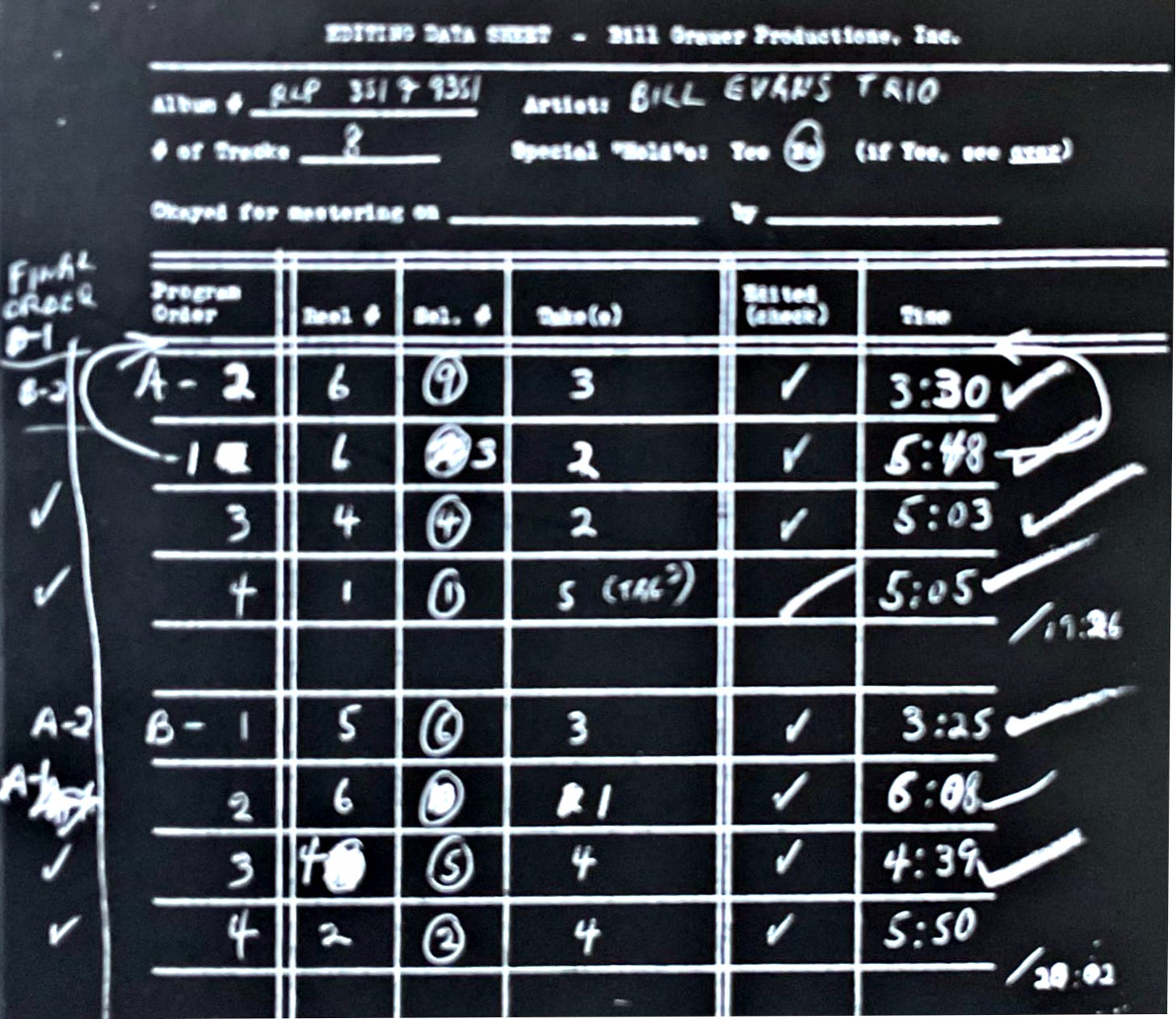
Editing Data Sheet, as reproduced in Haunted Heart (Craft). I’ve assembled this information into a sortable table (see “Explorations: Editing Data” below).
A couple things are immediately apparent: the sequence was tweaked twice, first when the first two tracks were swapped (indicated by the arrows), and second when it was decided to take the first two tracks from side B and use them to lead off the album instead (as shown in the left margin). Other questions are raised and unanswered: take 2 of “Nardis” is written over take 1: a clerical error or was take 1 originally deemed worthy of release? Was a tag added to “Elsa” (take 5) and is that why the check mark in the “Edited” column noticeably differs from the other rows? (Is that why the ending to “Elsa” is so striking?)
You may be wondering how I came up with song titles since none are shown on this form. Apparently Riverside did not employ matrix numbers, but selection numbers. The 2005 US issue of The Complete Live at the Village Vanguard 1961 (first issued in Japan in 2002) includes reproductions of “Recording Data Sheet” forms listing the contents of each reel. On those forms, “Sel. #” is again a circled digit with song titles indicated in the “Selection and Comments” column.
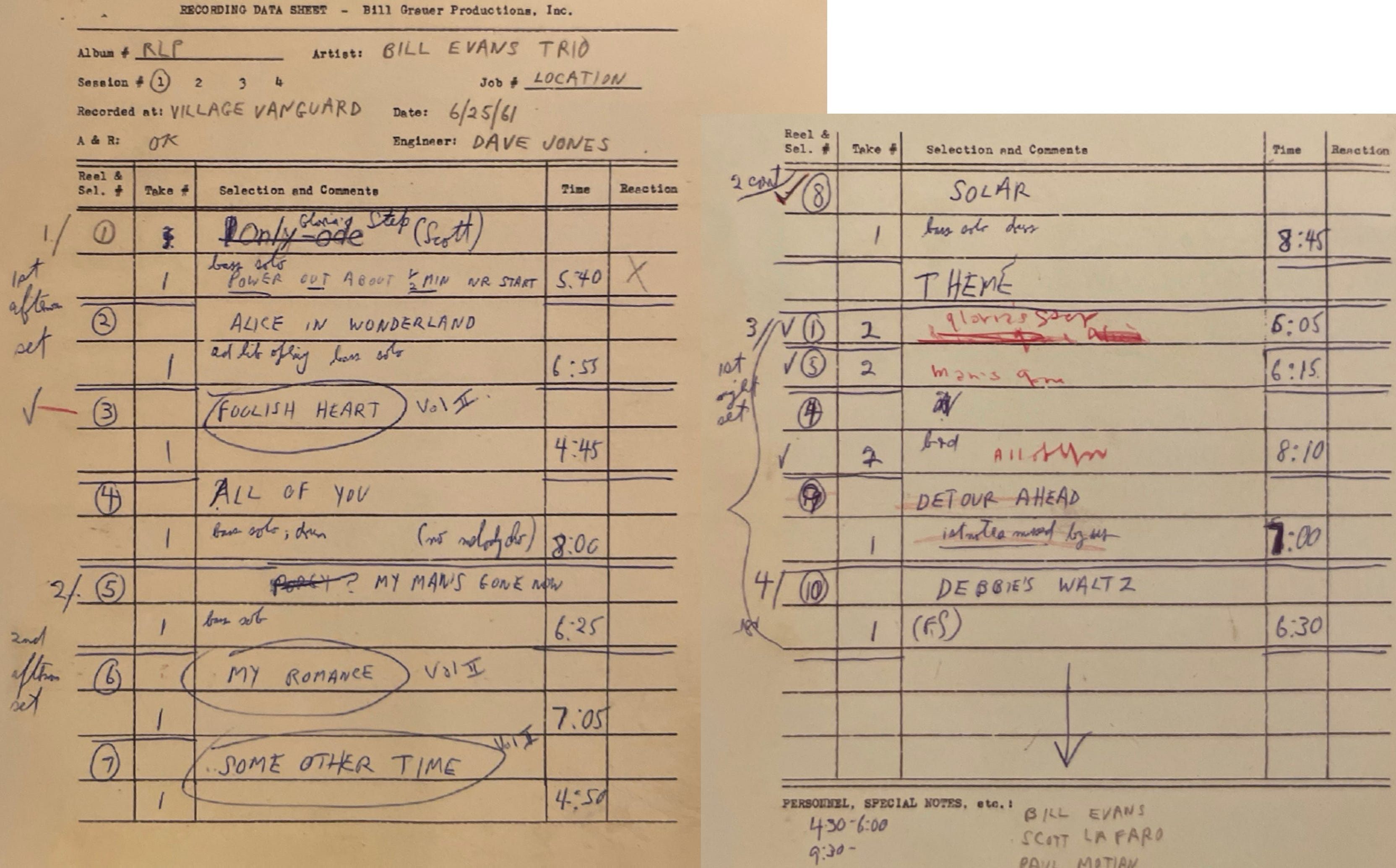
The first two (of three) Data Sheets for June 26, 1961.
On the second sheet, note the selection numbers for (1) “Gloria’s Step” and (5) “My Man’s Gone Now” correspond with the numbers they were given earlier that day.
Returning to the Explorations form: based on the selection numbers, we know the sequence of tunes as they were first tackled (click on “sel. #” to sort the table)…
…but that doesn’t mean that the trio finished work on (3) “Nardis” before turning to (4) “Beautiful Love.” In The Complete Riverside Recordings, Keepnews reveals that Evans departed from standard recording practice: instead of working on one tune at a time, he might abandon a tune after a few takes and turn to another, returning to the first tune later in the session. Keepnews notes that this disruptive practice probably resulted in fresher performances. Is it possible for us to reconstruct the session when we know the trio switched things up constantly?
The Complete Riverside Recordings did not reproduce the issued albums but instead released the tracks “in the exact sequence in which they were originally recorded,” which is to say: the masters were issued in order of completion (which differed from their initiation as indicated by the selection numbers). With these two pieces of data, I was able to produce a plausible reconstruction of the session, based on the following guiding principles:
selection number is the number assigned to each distinct tune when first attempted
The Complete Riverside Recordings provides the order the master takes were achieved
Craft’s take numbers indicate sequence (not order of preference)
assume sequential takes are consecutive without strong evidence to the contrary
That results in this hypothetical session log:
Elsa (alt-4, 2025)
Elsa (mst-5, 1961)
Elsa (alt-6, 2025)
Sweet and Lovely (alt-3, 2025)
Sweet and Lovely (mst-4, 1961)
Sweet and Lovely (alt-5, 2025)
Sweet and Lovely (alt-6, 2025)
Nardis (alt-1, 2025)
Beautiful Love (alt-1, 1984)
I Wish I Knew (inferred 1st attempt)
I Wish I Knew (alt-2, 2011)
I Wish I Knew (alt-3, 2025)
Haunted Heart (inferred 1st attempt)
Haunted Heart (alt-2, 2025)
The Boy Next Door (alt-1, 2025)
Walking Up (out-1, 2025)
Beautiful Love (mst-2, 1961)
How Deep Is the Ocean (alt-1, 2025)
How Deep Is the Ocean (alt-2, 2011)
I Wish I Knew (mst-4, 1961)
I Wish I Knew (alt-5, 2025)
The Boy Next Door (alt-4, 2011)
The Boy Next Door (mst-6, 1976)
Haunted Heart (mst-3, 1961)
Nardis (mst-2, 1961)
How Deep Is the Ocean (mst-3, 1961)
Israel (mst-1, 1961)
Explanatory notes:
mst = master, alt = alternate take, out = outtake
Years designate first release: 1960 (Portrait In Jazz), 1976 (Spring Leaves), 1984 (The Complete Riverside Recordings), 2011 (Portrait’s “OJC Remasters” edition), 2025 (Haunted Heart from Craft). (The “attempts” refer to inferred, unreleased recordings.)
Craft has grouped the alternate takes together and seems to have sequenced them by selection number, which would make “The Boy Next Door” and “Walking Up” selections 7 and 8 (respectively).
Since “The Boy Next Door” was dropped from the 1960 LP when Evans judged it the least successful, I am inferring that it was given consideration and that therefore take 6 is an “unissued master” rather than an “outtake” (as designated by Craft).
In The Complete Riverside Recordings, Keepnews reveals that “seven other numbers” came between the two takes of “Beautiful Love.” We know that work on “I Wish I Knew” began after “Beautiful Love” (1) with at most three takes (because “I Wish” [4] was completed after “Beautiful Love” [2]). Therefore, there must have been at least two takes of “Haunted Heart” next and at least one take of “The Boy Next Door.” Since we’re grouping versions together whenever possible, “The Boy” (4) is grouped with (6), so “Walking Up” precedes “Beautiful Love” (2) to get us to seven “numbers” between the two takes of “Beautiful Love.”
By the way, we can conclude that the “Beautiful Love” master did indeed precede that of “I Wish I Knew”: in Complete Riverside Recordings, Keepnews opts to group versions together by grouping alternates with the master and not the other way around.
Incredibly, this sequence suggests that the four master takes (five including “The Boy Next Door”) were achieved late in the session. Is this at all plausible? I refer you back to the sortable table: if you click on “Reel #” you’ll see that “Haunted Heart” was on reel 5 and the three other tracks were all on reel 6! Futhermore, “Beautiful Love” and “I Wish I Knew” were drawn from reel 4. That’s at least six of the originally issued eight tracks drawn from the late innings!
Turning our attention back to the early reels, something strange is going on with Motian’s kit: the drum solos reverberate on “Sweet and Lovely” (5), but neither (4) nor (6) have this problem. What could have happened (and would knowing the answer complicate my account of the session)? “Walking Up” and “Sweet and Lovely” are the only tunes where Motian solos with sticks instead of brushes, but that doesn’t explain why take 5 sounds different from the others. My best guess is that a fader was left up (maybe a mic on the double bass) for this one take.
So that’s my best attempt to reconstruct the February 2, 1961 recording sequence. Of course if the Recording Data forms had been shared with us, we’d know much more.
I want to close by addressing the original LP’s “Elsa”: is its striking conclusion the result of an edited tag? No take number is indicated for “TAG?” so we can’t know for certain. An unedited intro to “Minority” from Everybody Digs Bill Evans was inadvertently released on a CD issue, raising the possibility that Riverside could have been a little careless when notating edits (maybe I’ll write more about that album in a future post). The only thing we do know: the originally-issued recording concludes dramatically, if softly. Evans’s final chord is immediately extended by LaFaro’s plucked harmonic, which hangs in the air for a few seconds before the “full stop” punctuation of Motian’s kick drum.
Unsettling! Another mystery from this classic album! I wish we had better knowledge of the post-production work — but not at the cost of the album’s mystique. Sometimes you don’t want to know.
I think I might like Explorations these days more than Portrait In Jazz…