
GEORGE at Solar Myth
John Hollenbeck, Anna Webber, Chiquita Magic, and Sarah Rossy in Philadelphia (March 19, 2026)

John Hollenbeck conceived of his band GEORGE during COVID lockdown, convinced that multi-instrumentalist Aurora Nealand, Anna Webber (on sax and flutes), and the synthesizers and vocals of Isis Giraldo (better known as Chiquita Magic) would cohere quickly. This is not a combination I would have foreseen, but then I’m not a Guggenheim Fellow with an NEA grant on my resumé: Hollenbeck is. Now I hear the connections to Hollenbeck’s other bands: the synthesizers’ sonorities extend the sound of The Claudia Quintet’s accordion (held first by Ted Reichman and then Red Wierenga) while Hollenbeck’s affinity for vocalists is well established (his recorded history with Theo Bleckmann dates back to the mid-1990s). Still, on record I could never quite process how the band’s components resulted in such an enveloping and integrated sound, so I was eager to visit Solar Myth for a Thursday night concert featuring the new line-up (Sarah Rossy has taken the place of Nealand) in support of their new album, Looking for Consonance, to be released by Out of Your Head Records on May 8th).
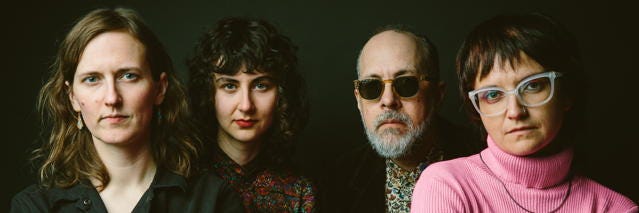
Photo: Evan Shay © 2024.
The band’s chemistry was on clear display early in their Northeast Tour. Hollenbeck has a deep understanding of Anna Webber, having made four albums since 2013 as part of her Simple Trio. Standing in front of Hollenbeck’s kit, Webber conducted the group during the opening number and locked eyes with Rossy when executing Hollenbeck’s challenging unison melody lines, syncing up and floating above the cascading drum rhythms. Elsewhere, as on “George and Dee,” Webber’s tenor sax doubled Giraldo’s keyboard. Rossy stood behind her Yamaha Reface CS synthesizer while Giraldo stood center stage, swaying from side to side as she interjected her synthesizer parts and vocals. Hollenbeck’s kit employed dual snare drums: with the snares disengaged he basically has a rack tom and a small floor tom in addition to the standard right-side floor tom. (When the snares are engaged, be prepared to duck!)
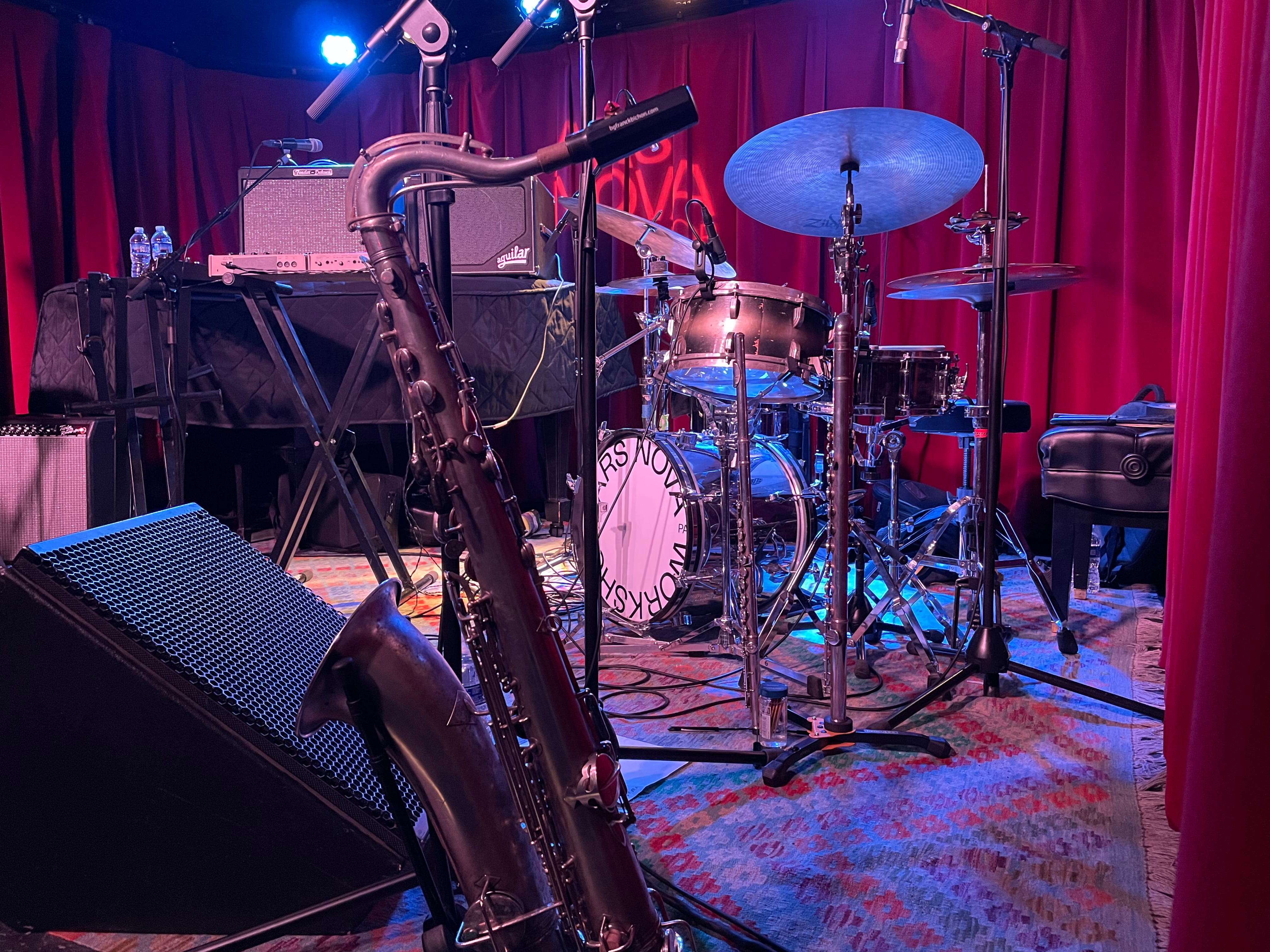
Webber’s axes and Hollenbeck’s dual snare drum set-up.
The band began by running down Side A of the new record. “bounce” is a great opener, launched by one of Hollenbeck’s patented drum salvos before turning the a capella spotlight upon its two “front-line soloists.” After a few turns through the composition’s two grooves (themes if you prefer), Webber explored tenor sax multiphonics (reaching them with a series of runs from the lower register all the way up). Rossy displayed her phenomenal control of vocal pitch and tone next. I eagerly anticipated the outtro (which extends the second theme and in its angularity almost sounds like a twelve-tone row: it’s actually a 11-note phrase and a 12-note variation).
On the set opener Chiquita Magic seemed to cover the role of bass and rhythm guitars, at time adding rhythmic backing vocals. (From the stage, Hollenbeck announced that the title referred to her ability to handle multiple synths, sing, and somehow also dance.) The second composition, “Lewis (dedicated to George Lewis),” assigned the unison melody to the two vocalists. I loved the texture Webber’s transparent sound on flute against Hollenbeck’s morphing straight-eight rhythms.
Hollenbeck’s multi-rod ruthe sticks provided a firm but gentle foundation for Rossy’s interpretation of “Nassam Alayna-LHawa” (by the Rahbani Brothers). While the leader announced most of the tunes himself, Rossy spoke to the personal meaning of the Lebanese song (as did Chiquita Magic after her feature, Silvio Rodriguez’s “Unicornio”).
Hollenbeck’s sincere but dry delivery had the band wryly grinning all night, as when he noted his inspiration to re-title “George and Dee” to thank a couple he spotted in the audience—but “they haven’t heard it yet” because they did not take in the second set that evening (”I’ll send them a file”). Hollenbeck also briefly glossed the contemporary relevance of 19th Century economist Henry George’s “land value tax” philosophy, enacted by Detroit’s Mayor Mike Duggan: “Georgist” features washes of sounds from Rossy’s and Giraldo’s synthesizers and in this context it became clear why Hollenbeck favors deadened drum and cymbal sounds: the reduced decay of his percussion leaves space for the overtones of the vocals and synthesizers to shimmer.
Having closed out side A of the new record, the band changed the pace with a lilting interpretation of “Kopolo,” the title track from the 2012 album released by Orchéstre Baka Gbiné of Central Africa. With the melody carried by Webber’s sax, and without OBG’s guitars, I found it impossible to identify the origin of the tune: on my notes I scribbled “post-modern Calypso?”
The political import of this selection became doubly clear when Hollenbeck suggested that we should seek out the album on Bandcamp to support the Baka people, whose semi-nomadic life is threatened by deforestation. Juxtaposing the pieces about land use in the rust belt and in Africa suggested a clear political message. (Here I’ll take the opportunity to remind you of Hollenbeck’s track, “I yield my time” -- name your price indeed!)
Following “Wayne Phases” (originally recorded by The Claudia Quintet), Chiquita Magic dedicated “Unicornio” to the resilience of Latinos and the Global South. After some performative hemming and hawing about whether the Philadelphia audience would be receptive to the closing piece, Hollenbeck announced “Norma (in support of reproductive autonomy),” named for Norma McCorvey. Given McCorvey’s complicated legacy, Hollenbeck’s subtitle is probably necessary: the composer also called attention to the baseball cap he wore: “1973.”
GEORGE began this tour on Tuesday in Goshen, MA, and stopped off in New York on the way to Philadelphia. They are playing tonight (March 20) at Firehouse 12 in New Haven before traveling to Cambridge’s Lilypad (March 21). In May they’ll perform at Long Play (Bang on a Can) and in Toronto at The Rex, in June they’ll appear at Wilco’s Solid Sound Festival.