
Ethan Iverson's Music for Mark Morris Dance Group
A commentary on disconnection

The Mark Morris Dance Group is visiting Philadelphia’s Zellerbach Theatre this Friday and Saturday. MMDG almost never performs to pre-recorded music, which means pianist Chris McCarthy will be in the hot seat, playing Gershwin’s “Preludes for Piano” and Ethan Iverson’s arrangements of 1920s songs (“Dancing Honeymoon”) and (ahem) James P. Johnson. Would YOU have the assurance to play “Charleston” in 5/4 for dancers?
I last saw MMDG performing The Look of Love (Iverson’s settings of well-loved Bacharach & David songs) and Pepperland (Iverson’s suite of Beatles songs from 1967, mostly from Sgt. Pepper plus “Penny Lane”). I posted my impressions of The Look of Love elsewhere in June 2024; an edited and revised version follows.
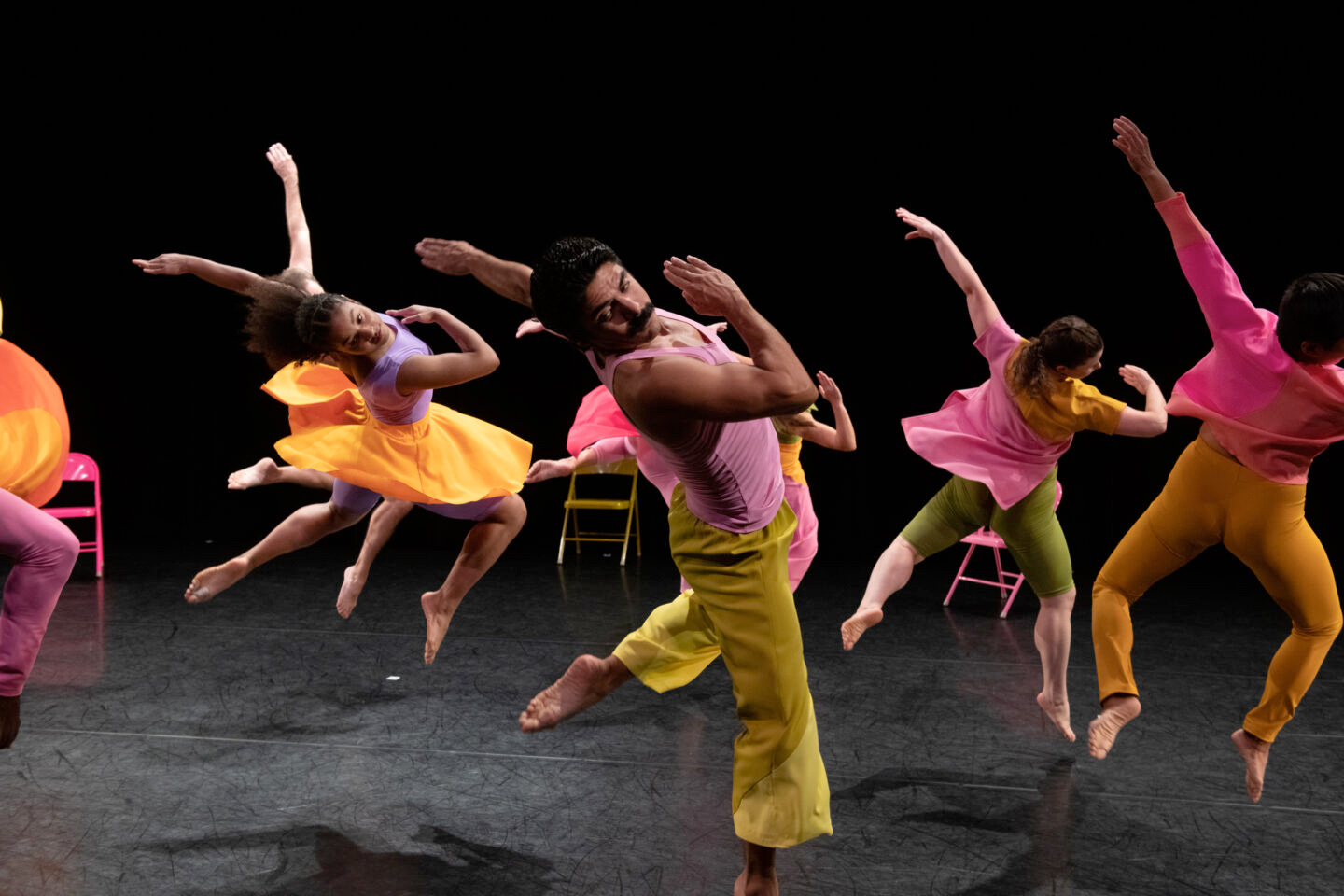
Image taken (without permission) from https://markmorrisdancegroup.org/work/the-look-of-love/
We call Sgt. Pepper’s Lonely Hearts Club Band a concept album, but it’s a“variety show” sequenced for stylistic contrast. Paradoxically, The Look of Love (assembled from songs Bacharach & David wrote for different artists, media, etc. from 1963-1969 — plus “The Blob” from 1958) has a clearer concept: obsessive love and the pernicious groupthink of how relationships are “supposed to be.” Most of the songs are sung by the dramatic and musical Marcy Harriell accompanied by piano trio, trumpet (open and muted), and two backing vocalists. Pepperland had a vocalist but many selections were NOT sung: “A Day in the Life” relies on the audience knowledge of the lyrics to recognize sidewalk gawkers (“a crowd of people stood & stared”) and running for the bus (“I noticed I was late”). Almost all of The Look of Love was sung.
Iverson played “Alfie” as prelude: restrained dynamics, triadic harmonies gradually expanded w/ passing tones (vs. the thick harmonies of Bill Evans). It was “high context” piano: I leaned in. I love Bill Evans but paradoxically he suddenly felt “one size fits all”: Iverson was tailored.
Allusions to “Alfie” were incorporated into the closing moments of the ballet piece, just as the dancers begin in a circle (five male-female pairs) and ended that way. (Pepperland had opened in a tight circle that unfolded and then tightened at the end — putting the record back in its jacket — and this was an intriguing callback.)
The songs on Sgt. Pepper’s Lonely Hearts Club Band are so well known that Iverson availed himself of the opportunity to reinterpret. By contrast, Bacharach’s arrangements, sung by vocalists ranging from Dionne Warwick to B.J. Thomas, have such a sturdy architecture that elements cannot be removed: like a buttressed cathedral, if you change anything it may stand but it looks weird, unsettling, wrong. That’s not to say Iverson didn’t bring personality: “Walk On By” interpolated an 8-to-the-bar left-hand bass-line, giving the striding dancers both a metronome (“if you see me walking on the street”) & a hint of insouciance that exposed the pedestrian’s forced bravado (”don’t! stop!”). (Vinnie Sperrazza provided another rhythmic option: a light but assertive downbeat and backbeat: thump-thwap-thump-thwap.)
I wasn’t sure how to interpret “Message to Michael”: upstage one dancer lip-synced into a handheld mic, addressing a group seated facing him, backs to audience. Of course this portrays Michael singing in cafés far from home, but other images came to mind: was this a support group for lovers thwarted by distance (my wife’s interpretation) or some kind of evangelist singing his own gospel (mine)? In the end most of the group rose and flew away (“Kentucky bluebird”).
I know I’m willfully misinterpreting Hal David’s lyrics! My point is that The Look of Love’s songs taken together are about people failing to connect, striving to reconnect, sometimes swapping partners, sometimes holding on to a delusion instead of facing the reality that it’s over. And sometimes the group mind of The Blob surrounds and assimilates you and refuses to let you stand on your own (like a cult).
Sgt. Pepper’s Lonely Hearts Club Band taught many that a record can be an artistic statement. Bacharach & David’s songs seem mere wallpaper, always there but not to be attended to. In Mark Morris and Ethan Iverson’s framing, Bacharach & David’s songs reveal the romantic mythos that undergirds the loneliness of metropolitan life.
I’m DJ Peter, a writer and radio deejay on WVUD and on WFMU’s Give The Drummer Radio (The Laughing Clock, Sundays 6-9pm ET, wfmu.org/playlists/LG). Standard procedure is to launch a newsletter with a statement of purpose, but I think that only makes sense if you want to know the famous writer’s focus on this particular platform. Since most of you don’t know me, I’m just going to post, as often as I can, which may not be that often. Because, you know, day job.